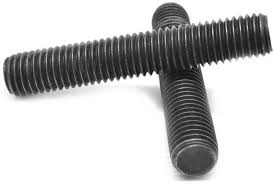
ASTM A193 Grade B7 stud bolts are high-strength, high-durability fasteners manufactured in accordance with the American Society for Testing and Materials (ASTM) A193 standard. They are made of alloy steel, quenched and tempered, and have excellent mechanical properties. They are widely used in various industrial equipment and structural connections that need to withstand high pressure and high temperature, such as petrochemical equipment, pressure vessels, pipeline flange connections, etc.
ASTM A193 Grade B7 Stud Bolts Specification
| Standard Specification Of | ASTM A193 Grade B7 Stud Bolts |
| Type Of Head | Hex, Threading, Square, Round |
| Size Type | Inches 3/8 to 3 |
| Surface Finish | Plain / Zinc plated / Hot dip galvanized |
| Standard Dimensions Of | ASME B18.2.1 |
ASTM A193 Standard
This specification” covers alloy and stainless steel bolting for pressure vessels, valves, flanges, and fittings for high temperature or high pressure service, or other special purpose applications. See Specification A962/A962M for the definition of bolting. Bars and wire shall be hot-wrought and may be further processed by center less grinding or by cold drawing. Austenitic stainless steel may be carbide solution treated or carbide solution treated and strain-hardened.When strain hardened austenitic steel is ordered, the purchaser should take special care to ensure that Appendix X1 is thoroughly under-stood.
High Temperature Tests
Tests to determine high temperature properties shall be made in accordance with Test Methods E21, E139, and E292, and Practices E150 andE151.
Charpy Impact Tests
Charpy impact tests based on the requirements of specification A320/A320M, shall be made as agreed between the manufacturer and the purchaser. When testing temperatures are as low as those specified in specification A320/A320M, bolting should be ordered to that specification in preference to this specification
100 % Hardness Testing of Grade B7M
Each Grade B7M bolt or stud shall be tested for hardness by indentation method and shall meet the requirements specified in tables
Length Tolerances for Bolts
| Nominal Length | Nominal Size | |||||
| 1/4 to 3/8 | 7/16 and 1/2 | 9/16 to 3/4 | 7/8 and 1 | 1 1/8 to 11/2 | Over 1 1/2 | |
| Up to 1 in,incl. | +0.02 | +0.02 | +0.02 | · | … | |
| -0.03 | -0.03 | -0.03 | · | · | ||
| Over 1 in.to 2 1/2 in,incl | +0.02 | +0.04 | +0.06 | +0.08 | +0.12 | +0.18 |
| -0.04 | -0.06 | -0.08 | -0.10 | -0.12 | -0.18 | |
| Over 2 1/2 in.to 4 in,incl | +0.04 | +0.06 | +0.08 | +0.10 | +0.16 | +0.20 |
| -0.06 | -0.08 | -0.10 | -0.14 | -0.16 | -0.20 | |
| Over 4 in.to 6 in,incl | +0.06 | +0.08 | +0.10 | +0.12 | +0.18 | +0.22 |
| -0.10 | -0.10 | -0.10 | -0.16 | -0.18 | -0.22 | |
| Longer than 6 in. | +0.10 | +0.12 | +0.14 | +0.16 | +0.22 | +0.24 |
| -0.18 | -0.18 | -0.18 | -0.20 | -0.22 | -0.24 | |
ASTM A193 Grade B7 Stud Bolts Material
ASTM A193 Grade B7 Chemical Composition
| CHEMICAL | LIMITS | C | Mn | P | S | Si | Cr |
| ASTM A193 Grade B7 | MIN | 0.37 | 0.65 | 0.15 | 0.75 | ||
| MAX | 0.49 | 1.10 | 0.035 | 0.040 | 0.35 | 1.20 |
Manganese is usually between 0.65 and 1.10%. Manganese helps to improve the strength, hardness and toughness of steel, and can improve the deoxidation and desulfurization effects of steel, enhancing the overall performance of steel.
ASTM A193 B7 Mechanical Property
| Grade | Size | Tensile ksi, min | Yield, ksi, min | Elong, %, min | RA % min | HBW | HRC |
| B7 | Up to 2-1/2 | 125 | 105 | 16 | 50 | 321 max | 35 max |
| 2-5/8 – 4 | 115 | 95 | 16 | 50 | |||
| 4-1/8 – 7 | 100 | 75 | 18 | 50 |
The minimum elongation of ASTM A193 Grade B7 stud bolts is 16%. A certain elongation indicates that the bolt has a certain plastic deformation capacity, which is very important when subjected to dynamic loads or uneven loads. It can adapt to stress changes through plastic deformation and prevent the bolt from breaking suddenly.
ASTM A193 Grade B7 Recommended Hardware
| Bolt Grade | Nuts | Washers |
| B7 | A194 Grade 2H | F436 |
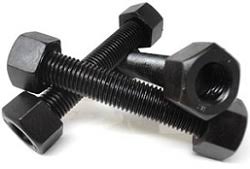
Difference Between A193 Grade B7 & A193 Grade B7M Stud bolts
Hardness is probably the most important difference between A193 B7M & A193 B7. The maximum hardness of ASTM A193 B7M is 235 HB or 99 HRB, while the maximum hardness of ASTM A193 Grade B7 stud bolts are 321 HB or 35 HRC. The most notable difference from a manufacturing perspective is that when supplying A193 B7M bolts, each individual bolt or stud in the batch must be tested for hardness. A193 B7M fasteners also require a different type of heavy-duty hex nut than A193 B7, namely ASTM A194 Grade 2HM.
While A193 B7 is specified relatively often in the construction industry, A193 B7M is a specification not seen as regularly. This makes it important to understand the differences between the two specifications so that the right material is ultimately supplied.